




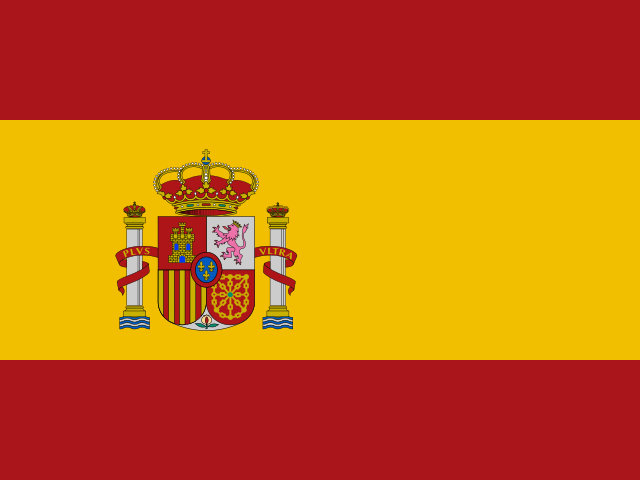


















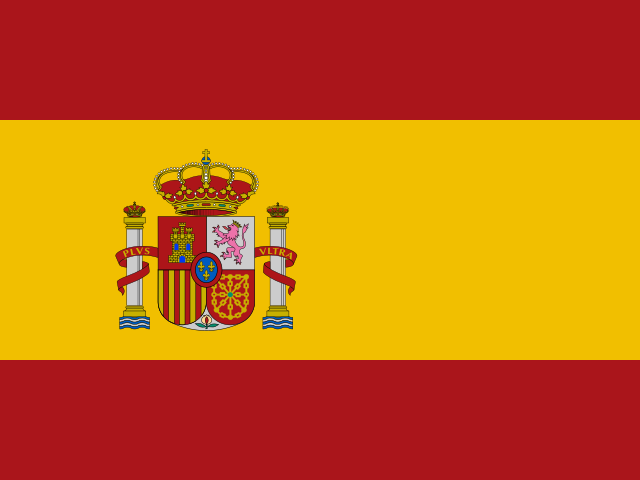


Professional debt collection in Spain
Are you struggling to get paid by a Spanish customer? Oddcoll makes debt collection in Spain simple and efficient. Through our platform, a local Spanish law firm can start recovering your unpaid invoices immediately.
Read on to learn how our proven process works.
Our approach to international debt collection
Recovering debts from foreign clients can be a complex and time-consuming process. Oddcoll simplifies international debt recovery by partnering with the world’s top debt collection agencies and law firms.
In Spain, we collaborate with an experienced local law firm that specializes in assisting international creditors in collecting debts from Spanish companies quickly and legally.
Our local experts handle:
- B2B and B2C debt recovery
- Amicable and judicial collection
- Enforcement and asset seizure, if necessary
Our local debt collection agency in Spain
Spanish businesses are known for slower B2B payments compared to other European countries. That’s why working with a Spanish debt collection agency is crucial when invoices go unpaid.
In Spain, Oddcoll partners with Cobro Ágil, a reputable law firm based in Madrid. As soon as you submit your case through our international debt collection platform, Cobro Ágil begins the recovery process.
About Cobro Ágil
Cobro Ágil is part of Alter Lex Abogados y Asesores, S.L., a Madrid-based law firm specializing in debt recovery. Their team of qualified professionals handles all aspects of claim management efficiently and professionally.
Amicable debt collection in Spain
Cobro Ágil manages every phase of amicable debt collection in Spain, including:
- Initial analysis: Evaluating the debtor’s situation and solvency.
- Contact attempts: Reaching out by phone and sending written payment requests signed by lawyers.
- Negotiation: Offering payment plans or debt acknowledgment agreements where appropriate.
If the debtor fails to respond, the case moves to the judicial phase.
Taking a debt collection case to court in Spain
When amicable recovery fails, judicial debt collection in Spain begins. In Spain, civil lawsuits must be filed with the court of first instance where the debtor resides. For companies, the case can also be filed in the area where the contract was fulfilled or where the debtor operates. Creditors can choose the most suitable option.
Requirements for legal action:
- A procurador (court representative) and a lawyer are generally required.
- Exceptions apply for claims under €2,000 or when using the order for payment process.
- Spanish is the official language used in court proceedings, although regional languages such as Catalan in Barcelona may also be accepted, depending on the location of the court.
Legal costs:
- Individuals do not pay court fees.
- Companies must pay a fee to take civil action.
- In all proceedings, Cobro Ágil requests that costs be awarded to the debtor—potentially adding up to 30% more to the total claim.
The order for the payment process in Spain
One of the most effective legal tools for judicial debt collection in Spain is the order for payment procedure (“proceso monitorio”). This process was designed to expedite and simplify the recovery of uncontested debts. It’s ideal for creditors seeking a streamlined way to collect payment from Spanish debtors without undergoing a full court trial.
How it works
When a Spanish debt collection agency such as Cobro Ágil files an order for payment, the court initially does not assess whether the claim is accurate. Instead, the process relies on the debtor’s response:
- If the debtor pays, the case is closed, and the creditor receives payment.
- If the debtor objects, the case moves to the ordinary civil procedure, where the court examines the dispute in detail.
- If the debtor does nothing, the court issues an enforcement order, confirming the validity of the claim and allowing the creditor to seize the debtor’s assets.
This fast-track procedure helps creditors avoid lengthy legal battles, particularly in cases that are clear and undisputed.
Key details of the process
- A power of attorney is required.
- The process involves court fees and procurator’s fees.
- Lawyer’s fees are covered by Cobro Ágil.
- If the debt exceeds €6,000, the case proceeds under the standard civil procedure.
Who can use the order for payment process in Spain?
There is no limit on the amount of the claim; the order for payment can be used for debts of any size. However, it is optional, meaning a creditor can choose to pursue the ordinary civil procedure instead if preferred.
The competent court for the order for payment is the same as for ordinary debt collection proceedings in Spain, generally, the court where the debtor resides. This applies nationwide, regardless of whether the debtor is based in Madrid, Barcelona, or elsewhere in Spain.
What to include in an order for payment application
To file an order for payment in Spain, the creditor must include:
- Full details of the debtor and the creditor
- The amount claimed
- A brief explanation of how the debt arose
These documents allow the Spanish court to confirm the existence of the claim and begin the enforcement process if the debtor fails to contest it.
For straightforward cases, the order for payment process offers a fast, efficient, and legally sound way to recover unpaid debts. With the support of a professional debt collection agency in Spain, such as Cobro Ágil, international creditors can take advantage of this process to secure payment quickly and avoid unnecessary complications.
Application for enforcement in a Spanish debt collection case
Once a creditor has obtained an enforcement order in Spain, the next step in judicial debt collection in Spain is to apply for enforcement. This allows the Spanish authorities to take legal action to transfer the debtor’s assets to the creditor.
The goal of this step is to ensure that payment is finally made through the intervention of the courts, if necessary. However, Spanish authorities cannot seize or liquidate assets without proper legal justification. That’s why an enforcement order confirming the existence of a valid debt is required.
What qualifies as an enforcement order?
In most cases of debt collection in Spain, an enforcement order comes from:
- A judgment issued during ordinary court proceedings, or
- A court decision from the order for payment process (proceso monitorio).
Once a creditor has one of these judgments, they can apply for enforcement to the same court that issued the ruling, typically the court of first instance in the area where the debtor is based.
This means that for cases handled through our debt collection agency in Madrid, enforcement is managed locally by the corresponding Spanish court.
Insolvency proceedings in Spain
In some cases, a Spanish debtor may be unable to pay their debts due to insolvency. When this happens, the situation enters the insolvency proceedings stage — a specialized branch of debt collection in Spain.
These proceedings are handled by Spanish courts, which appoint liquidators (administrators) to manage the debtor’s estate. The liquidator’s role includes:
- Overseeing the debtor’s remaining assets
- Listing all creditors and outstanding debts
- Ensuring assets are distributed fairly among all creditors
The goal is to maximize recovery and ensure equal treatment for all parties based on the available assets.
Start your debt collection in Spain today!
Do you want to get started with recovering your Spanish case right away? When you need help with debt collection in Spain, Oddcoll can help.
Contact us if you have any questions, or simply start a case, and our Spanish law firm will begin the collection process in Spain.