




Debt collection in Sweden

Expert debt collection in Sweden, conducted locally

‘After six months of struggling on my own, I got my money back in two weeks thanks to Oddcoll.’

“The website is so easy to use: you simply upload all the documents relating to the case, and then you can follow its progress until it’s closed. I received the payment about a week after the case was closed.

Oddcoll also recovered late fees that I was entitled to under Swedish law, which I didn’t even know about. In the end, I received more than the original debt, even after the collection fees were deducted.”

Henrik |
Gothenburg, Sweden
Rated 9,3 out of 10 based on 111 reviews on Kiyoh!

Key facts about debt collection in Sweden

Factor Information Source
Statute of limitations (B2B) 10 years (reset by written reminder or acknowledgment) Preskriptionslagen (1981:130), 2 & 5 §§
Late payment interest Riksbanken Reference Rate + 8% Räntelagen (1975:635), 6 §
Flat late payment compensation (B2B) SEK 450 per invoice Lag (1981:739), 4 a § (EU Directive 2011/7/EU)
Collection demand fee (inkassokrav) SEK 180 Lag (1981:739) om ersättning för inkassokostnader
Fast-track procedure Betalningsföreläggande (order to pay) via Kronofogden Lag (1990:746) om betalningsföreläggande
Application fee SEK 300 Kronofogden
Enforcement authority Kronofogden (Issues order and handles enforcement) Utsökningsbalken (1981:774)
Licensing requirement Permit required from Finansinspektionen (Swedish Financial Supervisory Authority) Inkassolagen (1974:182)
Contested cases Referred to District Court (Tingsrätt) Lag (1990:746), 33–36 §§
Currency SEK

Laws & regulations in Sweden

In general, Sweden has a strong payment culture. That said, it also has one of Europe’s most streamlined debt recovery systems. The process is centred on Kronofogden, the Swedish Enforcement Authority, which can both issue payment orders and enforce them. For foreign creditors, understanding how the system works can make debt recovery faster, simpler and less expensive.

'Inkassolagen' and good collection practice

Debt collection in Sweden is governed by the Debt Recovery Act, Inkassolagen (1974:182). It states that companies collecting debts on behalf of others must hold a permit from Finansinspektionen, the Swedish Financial Supervisory Authority. They must also follow god inkassosed, or good collection practice, which sets rules for how creditors and collection agencies can contact debtors.

Oddcoll’s Swedish partner is fully licensed, which means all claims will be handled in line with local collection rules from the first payment demand.

Debt limitation periods in Sweden ('preskription')

Under the Preskriptionslagen (1981:130), B2B claims in Sweden generally have a 10-year limitation period (consumer claims have a shorter three-year limitation period).

Unlike in most other parts of Europe, a written payment reminder can interrupt the limitation period under Section 5, restarting the full 10-year period.

For foreign creditors, this is particularly advantageous. However, it makes regular and properly documented payment reminders particularly important. A consistent reminder process can keep a Swedish B2B claim from becoming time-barred without the need to start court proceedings.

The key practical issue is being able to show that the debtor received the reminders, which a professional local partner can document.

Late payment interest and debt collection fees in Sweden

Swedish law provides creditors with specific rights to recover interest and certain collection costs.

Late payment interest is generally charged at the Riksbank reference rate plus eight percentage points under Section 6 of the Räntelagen. Where this has been agreed in advance, interest runs from the invoice due date. Otherwise, it generally starts 30 days after the invoice.

For B2B debts, creditors can also claim SEK 450 in late payment compensation, known as förseningsersättning, under rules implementing the EU Late Payment Directive.

Statutory collection costs, charged to the debtor, can also be added to the debt. These include:

  • SEK 60 for a payment reminder
  • SEK 180 for a formal collection demand, or inkassokrav
  • SEK 170 for setting up an instalment plan

The 'inkassokrav' formal collection demand

An inkassokrav is the formal collection demand regulated by the Inkassolagen Debt Recovery Act. It must identify the creditor and explain the basis of the claim, including the outstanding principal, interest and collection costs. It must also give the debtor a deadline for payment, normally at least eight days.

The inkassokrav is the usual escalation step after an unpaid reminder. Swedish debtors are familiar with what can follow: an application to Kronofogden (Swedish Enforcement Authority) and the potential consequences for their credit history (more below, see betalningsanmärkning).

As a result, a formal demand from a licensed Swedish collection agency can be enough to prompt payment without further legal action.

'Betalningsföreläggande': Sweden's fast-track debt recovery procedure

Sweden has a fast-track debt recovery procedure that does not initially require court proceedings. Instead, creditors can apply directly to Kronofogden (Swedish Enforcement Authority) for a betalningsföreläggande, or order to pay.

The application costs SEK 300 and sets out the parties involved, the amount owed, interest and any applicable costs.

The process generally works as follows:

  1. The creditor submits an application to Kronofogden.
  2. Kronofogden serves the claim on the debtor.
  3. The debtor is given a short period, normally around 10 days from service, to pay or object.
  4. If the debtor doesn’t object, Kronofogden issues an utslag, which can be enforced.
  5. Kronofogden can then begin enforcement without the creditor having to start separate enforcement proceedings.

An uncontested claim will typically result in an enforceable decision within four to eight weeks. If the debtor objects, the creditor can choose to take the case to the district court (tingsrätt).

'Betalningsanmärkning': Sweden's payment remark system

The betalningsanmärkning is an important part of Sweden’s debt recovery system. Credit reference agencies can register a payment remark when a claim reaches the relevant stage of the Kronofogden process. For companies, a remark can appear as soon as an application is filed.

A betalningsanmärkning can have serious consequences for companies, affecting access to credit, leasing, suppliers and commercial contracts. It can remain visible for several years.

Therefore, just the risk of receiving a betalningsanmärkning can encourage solvent companies to settle a genuine debt before the case progresses further.

Enforcement and asset attachment

Once a creditor has a court judgment (utslag), Kronofogden can enforce the debt through utmätning (attachment).

Depending on the circumstances, enforcement can include:

  • Attachment of bank accounts and other financial assets
  • Attachment of receivables owed to the debtor
  • Seizure of movable assets
  • Seizure of real property (larger claims)
  • Wage garnishment (löneutmätning)

As Kronofogden is a State authority with access to extensive information about debtors and their assets, this gives Sweden a centralised enforcement system that can make the recovery of undisputed debts relatively quick and cost-effective compared to other countries.

How Sweden compares: B2B debt collection across Europe

Country Limitation period B2B late interest Fast-track procedure Typical duration*
Sweden Sweden 10 years, restarted by reminder (Preskriptionslagen) Reference rate + 8% (Räntelagen 6 §) Betalningsföreläggande 2–4 weeks
Germany Germany 3 years (§ 195 BGB) Base rate + 9% (§ 288 II BGB) Mahnverfahren 2–4 weeks
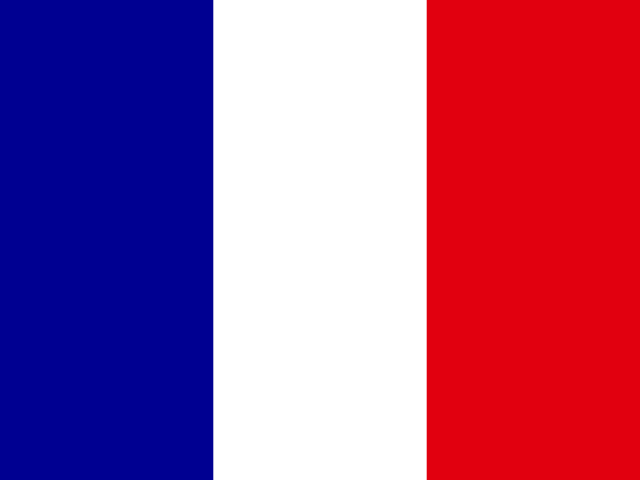
France France 5 years (Art. L110-4 C. com.) ECB + 10% (Art. L441-10) Injonction de payer 4–8 weeks
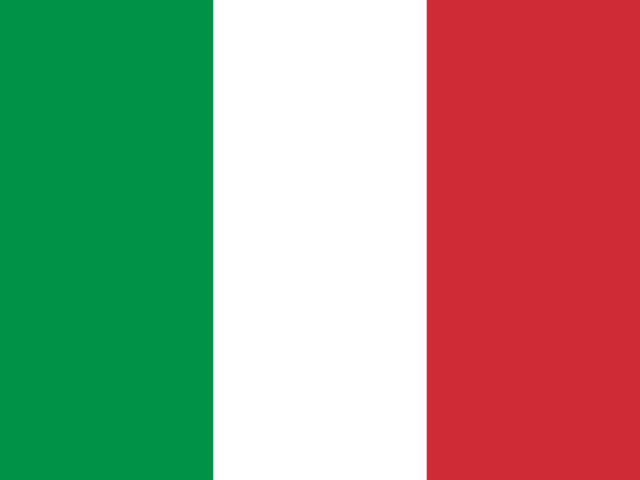
Italy Italy 10 years (Art. 2946 CC) ECB + 8% (D.Lgs. 231/2002) Decreto ingiuntivo 4–8 weeks
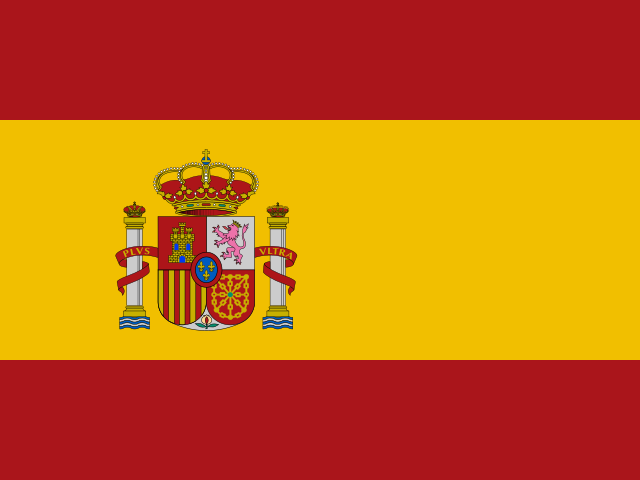
Spain Spain 5 years (Art. 1964.2 CC) Base rate + 8% (Ley 3/2004) Proceso monitorio 4–8 weeks
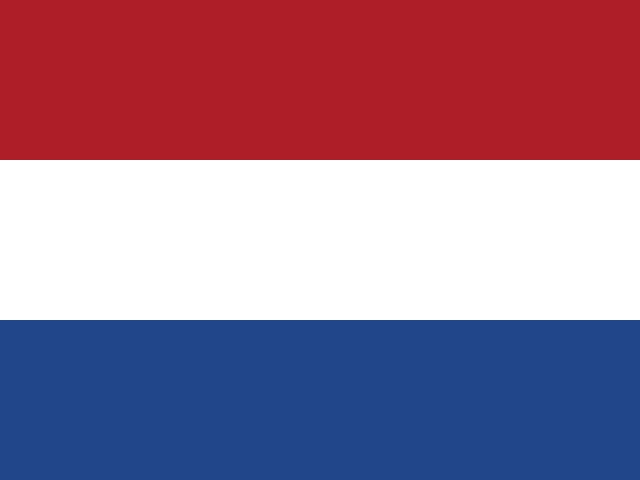
Netherlands Netherlands 5 years (Art. 3:307 BW) Base rate + 8% (Art. 6:119a BW) Betalingsbevel 2–4 weeks

* Amicable phase only. Legal proceedings add 1–6 months depending on debtor response and court scheduling.

Companies we helped get paid by their clients abroad!
+ 0
Get free consultation

Get help with debt collection in Sweden

Get started today!

Do you have a debt to be collected?

Talk to us direct on Whatsapp
10 years
— the general B2B limitation period in Sweden. A written demand or reminder from the creditor interrupts limitation and starts a new 10-year period.
Preskriptionslagen (1981:130)
SEK 300
— the current application fee for a payment order through Kronofogden, one of the cheapest in Europe.
Kronofogden
SEK 450
— the statutory late payment compensation available for overdue B2B invoices.
Lag (1981:739), 4 a §
65 days
— typical time to an enforceable title for an uncontested claim via 'betalningsföreläggande'
Kronofogden, 2025
25%
of bankruptcies in Europe are caused by late payments
EU Council
Reference rate + 8%
— statutory late payment interest in Sweden
Räntelagen (1975:635), 6 §

Let's us help you get paid

Submit your case directly

Regional expert in Sweden

Insider perspective from our local debt collection partner

Regional expert in Sweden

Our local partner has handled commercial debt recovery in Sweden for many years. Here are their key insights for foreign creditors.

First contact

"Swedish debtors take a licensed agency's demand letter seriously, because everyone knows what comes next: enforcement action and a payment remark. A correctly formatted demand under Swedish debt collection law resolves most cases before they go any further."

Payment remarks

"The payment remark is the strongest leverage you have in Swedish collection. One mark on a company's credit record can lock it out of credit, leasing and supplier terms for years, so solvent debtors will almost always pay rather than risk it."

Summary payment order

"Foreign creditors are often surprised that legal collection in Sweden costs a few hundred kronor and, for uncontested claims, never touches a courtroom. The enforcement authority issues the order and enforces it, so it's one body handling the whole process, no lawyer needed."

Timing and the limitation rule

"Sweden's ten-year limitation period, and the fact that a written reminder restarts the clock, gives you room to work with. But don't let that breed complacency. Recovery rates still drop sharply the longer a claim sits, so use the rule to keep old debts alive, not as a reason to wait."

Cultural approach

"Swedish business culture rewards correctness over drama. A factual, polite, well-documented process gets you paid; aggressive tactics breach good collection practice and cost you credibility. The system's built to deliver results, so trust it to do its job."

Frequently asked questions about debt collection in Sweden

Debt collection in Sweden normally starts with a payment reminder or an inkassokrav, the formal Swedish debt collection demand. The creditor can then apply to Kronofogden, the Swedish Enforcement Authority, for a betalningsföreläggande if the debt remains unpaid. If the debtor doesn’t dispute the claim, Kronofogden can issue an utslag, which can form the basis for enforcement.

Oddcoll handles the process through a licensed local partner in Sweden. The partner communicates with the debtor in Swedish, sends compliant collection demands and can take the claim to Kronofogden when amicable debt recovery does not result in payment. Professional local handling helps you follow Swedish collection rules without having to manage the process yourself.

The time required to recover a debt in Sweden depends on whether the debtor pays voluntarily, disputes the claim or has assets that can be used to satisfy the debt.

Amicable collection is generally the quickest route. If the debtor doesn’t pay, a creditor can apply to Kronofogden for a betalningsföreläggande. An uncontested claim can then proceed to an utslag and enforcement. Disputed claims may need to be taken to the district court, which can take considerably longer.

Oddcoll aims to resolve Swedish debt collection cases at the amicable stage wherever possible, while keeping legal recovery as an option when it is appropriate.

Oddcoll offers debt collection in Sweden on a no-win, no-fee basis for the amicable collection stage, with a commission charged only on money recovered.

Swedish law also allows certain collection costs to be claimed from the debtor. A payment reminder can cost up to SEK 60 where the relevant conditions are met, while an inkassokrav can carry a collection cost of up to SEK 180 per claim. Applying to Kronofogden for a betalningsföreläggande currently costs SEK 300. These costs may be recoverable from the debtor.

The general limitation period for a claim in Sweden is 10 years. For certain claims made by a business against a consumer for goods or services supplied for private use, the limitation period is three years.

The limitation period can be interrupted in several ways. For example, a written demand or reminder from the creditor can interrupt prescription, after which a new limitation period begins. A debtor’s acknowledgement of the debt or payment of interest or part of the debt can also interrupt the period.

This makes it important to keep accurate records of reminders and other collection activity when pursuing an old Swedish debt.

An inkassokrav is a formal debt collection demand sent to a debtor in Sweden. It sets out the debt and tells the debtor what may happen if they don’t pay or dispute the claim.

Swedish debt collection is regulated by the Inkassolagen, the Swedish Debt Collection Act. Businesses carrying out professional debt collection for another party generally need authorisation from Finansinspektionen, Sweden’s financial supervisory authority.

Swedish rules also set requirements for the content of an inkassokrav and the time given to the debtor. The applicable guidance has traditionally provided for a payment period of at least eight days, subject to the circumstances and the method of delivery.

Oddcoll’s local Swedish partner handles the collection demand in accordance with Swedish requirements and communicates with the debtor in Swedish.

A betalningsföreläggande is Sweden’s order-to-pay procedure for recovering an unpaid debt through Kronofogden. It can be used for many types of money claims between businesses and individuals once the payment due date has passed.

The application fee is currently SEK 300. If the debtor does not dispute the claim, Kronofogden can issue an utslag confirming the claim. The creditor can then request enforcement of the debt. If the debtor disputes the claim, the matter cannot simply proceed to an utslag and may instead need to be taken to the district court.

Oddcoll can assess the case and, where appropriate, arrange for the claim to proceed to Kronofogden.

A betalningsanmärkning is a payment remark recorded by a Swedish credit reference agency. It can affect a company’s ability to obtain credit and other financial services.

For companies, an application for a betalningsföreläggande can itself be recorded in credit information registers. However, for individuals and sole traders, an application alone does not normally result in a payment remark.

This distinction is important when pursuing Swedish business debts. The potential impact on a company’s credit record can provide an additional incentive to resolve an unpaid claim before it progresses further.

If a debtor disputes a claim submitted to Kronofogden, Kronofogden cannot issue an utslag on the disputed claim. The creditor must then decide whether to take the matter to the district court, or tingsrätt, for a judgment.

Whether court action is worthwhile depends on factors such as the amount owed, the evidence supporting the claim and the debtor’s financial position. Oddcoll can assess the circumstances and help you decide whether further legal recovery is appropriate.

An unpaid invoice and details of the debt are normally enough to start a debt collection case. That said, information that can support the claim includes the contract, purchase order, order confirmation, delivery records, correspondence and proof that the invoice was issued and became due.

If the case proceeds to Kronofogden, the application must include details such as the parties involved, the amount claimed, the due date, interest and the basis of the claim. Kronofogden recommends providing enough information to make clear what the debt relates to.

Oddcoll can review the available documentation and tell you what is needed to start your Swedish debt collection case.

The chances of recovery depend mainly on the validity of the claim and the debtor’s ability and willingness to pay. Sweden has a well-established debt collection system, with professional inkasso followed by the Kronofogden procedure for unpaid claims.

Using a local debt collection partner can make the process easier for international creditors. Oddcoll’s Swedish partner communicates with debtors in Swedish, handles the local collection process and can escalate suitable cases to Kronofogden. This gives you a practical way to pursue Swedish debts without having to manage the local procedure yourself.

Oddcoll helps you all the way​

How debt collection in Sweden works

1. Upload your invoice

Create an account and upload your invoice via the platform, API or CSV – easily and in seconds.

2. Local experts take over

Our hand-picked partners in Sweden handle the collection with effective measures, including demand letters, calls and legal steps.

3. Get paid

Once the payment is completed, the money is sent directly to you – quickly, securely and without hassle.

Expert debt collection in Sweden

Chasing unpaid invoices from a Swedish customer? The fastest way to get paid is to work with someone on the ground.

Oddcoll connects you with a licensed Swedish debt collection partner who deals with your debtor directly in Swedish, under Swedish law.

That local presence changes everything: debtors respond differently to a compliant inkassokrav from a Swedish agency than they do to a letter from abroad – and cases move faster as a result.

You can set up a case with us in minutes, and your partner starts working it straight away.

Debt collection in Stockholm, Gothenburg, Malmö and beyond

It doesn’t matter where in Sweden your debtor is based. Our handpicked B2B debt collection partner handles cases across the whole country, from Stockholm to Gothenburg and everywhere in between, with the same process and the same standards throughout.

By partnering with Oddcoll, you can expect:

  • Recovery that moves quickly, without unnecessary delays
  • Clear updates at every stage, so you’re never left wondering
  • A collection process that protects the relationship with your customer
  • An approach that reflects well on your business, not just your bottom line

Why businesses use Oddcoll for debt collection in Sweden

Oddcoll was built for companies selling across borders. We’ve put together a network of vetted debt collection agencies and law firms around the world, so every claim lands with people who actually know the local law and how things get done there.

For Sweden specifically, that means:

  • One trusted, licensed partner handling your case, not a rotating cast
  • A focus on commercial debt (business-to-business, not consumer claims)
  • Full visibility into your case at every step, through our online platform

Meet our Swedish debt collection partner

Sweden is actually where Oddcoll started, so this is a market we know from the inside out.

Our Swedish partner holds an Finansinspektionen permit under the Inkassolagen and treats your claim exactly as a domestic creditor would: a compliant inkassokrav, direct contact in Swedish, and escalation to Kronofogden if the case calls for it.

Here’s what happens once you get started:

  1. You upload your claim through our platform.
  2. Our Swedish partner picks it up and gets to work immediately.
  3. From there, it’s handled as a local Swedish case, which is exactly what gives it the best shot at a fast, full recovery.

Get started with debt collection in Sweden

If you’re owed money by a Swedish customer, don’t let it sit. Upload the invoice through our platform and our partner will be on it straight away.

Got questions first? Get in touch with our team and we’ll talk through your case.

Get free consultation