







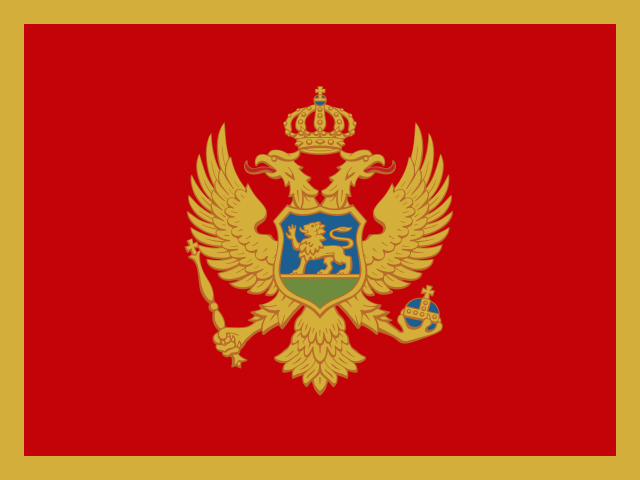


Debt collection in Montenegro with Oddcoll
Debt collection in Montenegro follows a structured legal and procedural framework based on continental European civil-law traditions. For companies dealing with unpaid invoices from Montenegrin businesses, understanding how local and international debt collection in Montenegro works is critical to achieving successful recovery. Although the process can seem complex, Montenegro offers clear rules for amicable recovery, legal procedures, enforcement mechanisms, and insolvency actions. With proper knowledge, creditors can significantly increase their chances of securing payment.
Out-of-Court Debt Collection in Montenegro
The first and most important step in debt collection in Montenegro is the out-of-court or amicable phase. Montenegrin law encourages creditors to pursue a voluntary settlement before escalating a case to court. This pre-legal stage typically involves:
- Sending a written demand for payment
- Attempting negotiation with the debtor
- Offering revised payment arrangements
- Using mediation or other forms of alternative dispute resolution
- Contacting the debtor through a Montenegro debt collection agency
This stage is efficient, cost-effective, and often leads to settlement, especially when handled by a professional collection partner familiar with local practices. Many Montenegrin businesses prefer resolving disputes before they escalate into formal legal proceedings, making the amicable phase a crucial step for both local and international creditors.
Regulations and Requirements for Debt Collection
Montenegro does not require a special governmental license to conduct debt collection activities. However, creditors must adhere to applicable laws and regulations, including:
- The Law on Obligations
- The Civil Procedure Code
- The Law on Enforcement and Securing of Claims
- Rules governing communication with debtors
- Data protection and privacy regulations
Collection activities must be conducted fairly, transparently, and in accordance with Montenegrin civil-law principles.
Montenegro’s Legal System for Debt Recovery
Montenegro’s judiciary is based on the continental European civil-law model and includes:
- Basic Courts – for standard civil disputes and debt claims
- Higher Courts – for appeals
- Supreme Court – the highest appellate authority
Most debt claims, especially B2B disputes, are filed in the Basic Court with subject-matter jurisdiction.
Legal proceedings in Montenegro involve:
- Filing a lawsuit with supporting evidence
- Service of notice to the debtor
- Preliminary review and hearings
- A judicial decision
- Possible appeals from either party
Because Montenegrin courts require extensive documentation, creditors should prepare contracts, invoices, delivery confirmations, statements of account, and any correspondence acknowledging the debt.
Summary Judicial Procedure for Uncontested Claims
For unpaid but uncontested claims, Montenegro offers a summary judicial process (simplified procedure). This accelerated procedure is available when:
- The debt is clearly documented
- The debtor does not dispute the obligation
- The claim meets specific statutory criteria
The summary procedure allows the court to reach a decision more quickly, often without the need for lengthy hearings. This makes it highly efficient for international creditors dealing with straightforward debt cases.
Full Litigation for Contested Claims
If the debtor contests the claim, the case proceeds through full civil litigation. This process can be:
- Time-consuming
- More costly
- Dependent on the complexity of the documentation
- Subject to multiple hearings
Because of these factors, foreign creditors often benefit from using a Montenegro debt collection agency or a local attorney to represent their interests and ensure procedural compliance.
Limitation Periods for Debt Claims in Montenegro
The statute of limitations in Montenegro depends on the type of claim. General limitation periods include:
- 3 years – standard monetary claims arising from commercial transactions
- 5 to 10 years – various non-monetary or long-term contractual obligations
The limitation period begins on the date the claim becomes due. Actions such as partial payments or written acknowledgment by the debtor can restart the limitation period.
Monitoring deadlines is crucial, especially for international creditors unfamiliar with local time limits.
Alternative Dispute Resolution (ADR)
Montenegro actively promotes alternative dispute resolution, which includes:
- Mediation
- Arbitration
- Conciliation
ADR methods are often faster, less expensive, and more flexible than traditional court proceedings. Many commercial contracts involving foreign companies include arbitration clauses, allowing disputes to be resolved either in Montenegro or in a neutral jurisdiction.
Arbitration awards can generally be enforced in Montenegro under applicable laws and international conventions.
Enforcement of Court Decisions in Montenegro
Once a creditor obtains a court judgment or an enforceable title, the next step is enforcement. Montenegro uses a structured enforcement system regulated by the Law on Enforcement and Securing of Claims.
Enforcement officers can execute actions such as:
- Seizing movable assets
- Garnishing wages or bank accounts
- Freezing financial assets
- Seizing real estate and conducting public auctions
- Collecting receivables from third parties
Creditors must apply for an enforcement order, which the court issues when the judgment becomes final. Enforcement officers then implement the measures required to recover the debt.
Enforcement efficiency varies depending on the type of assets available and the debtor’s cooperation. However, Montenegro’s enforcement framework is generally considered well-structured compared to similar jurisdictions in the region.
Insolvency Proceedings in Montenegro
If the debtor is insolvent, creditors can initiate or participate in insolvency proceedings. Montenegrin insolvency law outlines several options:
Bankruptcy
Complete liquidation of the debtor’s assets and distribution to creditors.
Reorganization / Financial Restructuring
A plan approved by creditors that allows the debtor to continue operating while repaying debts over time.
Pre-bankruptcy Settlement
A negotiated agreement between the debtor and creditors to avoid complete bankruptcy.
Creditors must register their claims with the insolvency administrator to participate in distributions. Priority ranking affects how much each creditor ultimately receives.
Conclusion
Debt collection in Montenegro involves a combination of amicable negotiation, well-defined civil-law procedures, efficient summary processes for uncontested claims, and structured enforcement mechanisms. By understanding the legal framework and the steps involved, from out-of-court recovery to court proceedings, enforcement, and insolvency, creditors can navigate the system effectively.
For international companies, working with a specialized Montenegro debt collection agency or local legal expert significantly increases the likelihood of successful international debt recovery in Montenegro.